
Resin
Urea Formaldehyde Resin
General Information
- Composition: Made by reacting urea and formaldehyde
- Properties: Thermosetting, durable, and thermally stable
- Applications: Commonly used as wood adhesive, coatings, and moulding compound.
- Advantages: Affordable, versatile
- Concerns: Associated with formaldehyde emissions; efforts made for lowformaldehyde alternatives.
- Environmental Impact: Not considered biodegradable; alternatives sought for sustainability


| Appearance | PH at 30 ±1℃ | VISCOSITY at 30 ±1℃ mpas | DENSITY at 30 ±1℃ g/ml | Solid Content % | Gel Time (second) | SHELF LIFE | Water Tolerance |
|---|---|---|---|---|---|---|---|
| White - S.D. W | 8.0 − 9.0 | 150 − 200 | 1.260 − 1.300 | 59.0 − 60.5 | 50 − 75 | 21 Days approx | - |
Uses
- Wood Adhesives: Bonds wood in woodworking applications
- Particleboard/MDF Production: Used as a binder in engineered wood products.
- Coatings and Finishes: Provides durability and chemical resistance.
- Moulding Compounds: Creates heat-resistant molded products.
- Paper Impregnation: Enhances strength and durability of paper.
Melamine formaldehyde Resin
General Information
- Composition: Polymer derived from melamine and formaldehyde
- Properties: Durable, heat-resistant, and resistant to chemicals.
- Advantages: Scratch-resistant, maintains color, and has high heat resistance
- Concerns: Potential for formaldehyde emissions; efforts for low-emission formulations.
| Appearance | PH at 30 ±1℃ | VISCOSITY at 30 ±1℃ mpas | DENSITY at 30 ±1℃ g/ml | Solid Content % | Cloud Time (Minutes) | SHELF LIFE | Water Tolerance |
|---|---|---|---|---|---|---|---|
| Clear - S. Hazy | 9.2 − 9.800 | 25 − 45 | 1.210 − 1.230 | 49.5 − 50.5 | 9-24 | 15 Days approx | 1: 1.5 − 1: 2.5 |
Uses
- Decorative Laminates: Commonly used on furniture and surfaces.
- Coatings: Provides scratch-resistant finishes on various materials.
- Adhesives: Forms strong bonds in woodworking.
- Fire Retardant Applications: Used as an additive in some materials.
- Construction: Applied as a protective and decorative surface coating.
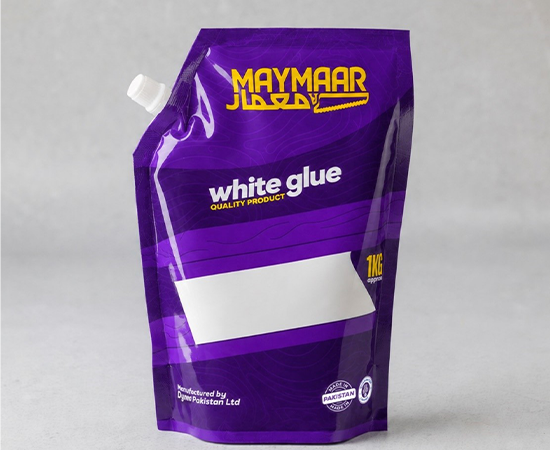
Maymaar (White Glue)
General Information
- Composition: Vinyl Acetate Homopolymer Latex Emulsion
- Properties: Water-based, high bond strength, smooth application, weather-resistant, and eco-friendly
- Applications: Used for wood bonding, paper crafts, laminates, boards, packaging, and artistic applications
- Advantages: Strong bonding, easy spreadability, non-corrosive, low-volatile formulation, and clear film finish
- Concerns: Avoid prolonged skin and eye contact; store away from freezing temperatures and direct sunlight
- Environmental Impact: Water-based and eco-friendly formulation with low volatile content
| Appearance | Composition | Solid Content | pH Value | Solubility | Film Type | Viscosity at 25°C | Shelf Life |
|---|---|---|---|---|---|---|---|
| White viscous dispersion | Vinyl Acetate Homopolymer Latex Emulsion | 30 ±1 % | 4.5 – 5.5 | Water soluble | Clear | 75000 – 85000 cp | Up to 06 months |
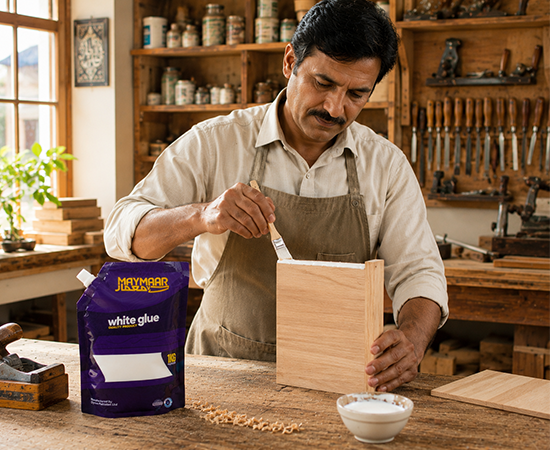
Uses
- Wood Bonding: Suitable for all types of wood and wood-based materials
- Laminates & Boards: Ideal for flat laminates, softboard, hardboard, chipboard, and synthetic resin boards
- Paper & Packaging: Effective for corrugated paper, paper tubes, and foil paper bonding
- Arts & Crafts: Perfect for school projects, artistic work, and handicraft applications
- Architectural Applications: Can be used with acrylates for architectural bonding and surface applications
Paint Grade Binders (PVA, Styrene Acrylic & Pure Acrylic)
General Information
- Composition: Water-based Vinyl Acetate/Acrylates copolymer emulsion
- Properties: Medium-viscosity, flexible film formation, excellent scrub resistance, and high pigment binding capacity
- Applications: Used in decorative and architectural interior emulsion paints, texture coatings, and deep shade paints
- Advantages: Low VOC content, enhanced opacity, excellent gloss and hiding power, weather resistance, and non-plasticized formulation
- Concerns: Protect from freezing and excessive heat; avoid prolonged exposure to sunlight and contamination
- Environmental Impact: Water-based formulation with low residual monomer and VOC levels
| Appearance | Composition | Solid Content | pH Value of PVA & Pure Acrylic | Solubility | Film Type | Ionic Character | Viscosity at 25°C | Shelf Life |
|---|---|---|---|---|---|---|---|---|
| Milky white liquid with bluish tone | V/AC Copolymer | 50 - 55 ±1 % | 4.5 – 5.5 | pH value of Styrene Acrylic: 7.5 – 8.5 | Soluble in water | Clear, non-tacky & flexible | Nonionic | 2000 – 4000 cp | Up to 06 months |
Uses
- Premium Interior Paints: Suitable for high-quality interior flat, exterior, and semi-gloss emulsion paints
- Texture Coatings: Ideal for decorative texture coating applications
- Deep Shade Paints: Effective for low to deep shade paints due to high wetting power
- Architectural Coatings: Provides excellent gloss, opacity, and weather resistance for architectural finishes
- Pigment Binding Applications: Ensures strong pigment binding and improved coating durability

